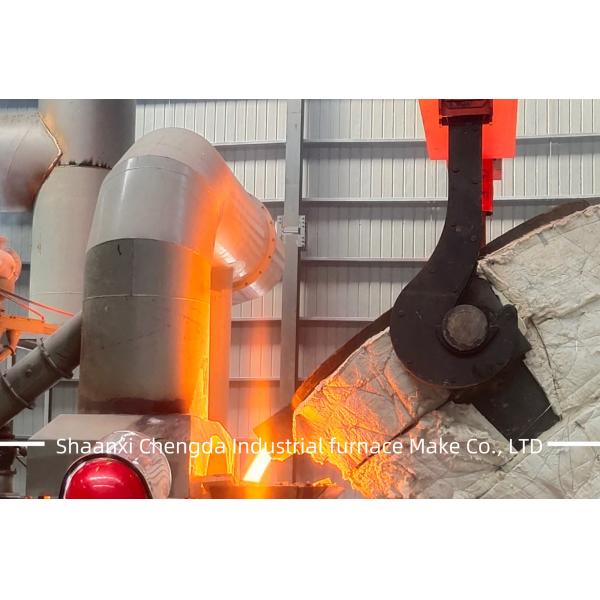
Electric arc furnaces (EAFs) are high-temperature thermal
processing equipment that generates heat through electric arcs
between electrodes and materials. In the chemical and new materials
industries, they are uniquely suited for high-temperature smelting, pyrolysis, reduction, and synthesis of special materials—especially those requiring ultra-high
temperatures (above 1600°C) or processing under harsh conditions
(e.g., reducing atmospheres, molten salt environments). Below is a
detailed overview of their processing principles, core process
links, key process parameters, typical application scenarios, and
operational characteristics.
The core of EAF processing lies in electric arc heating: three graphite (or metal) electrodes extend into the furnace
chamber, and a high-voltage electric field is applied between the
electrodes and the material (or between electrodes). When the
voltage reaches the breakdown voltage of the air (or medium) in the
furnace, a high-temperature electric arc (3000–6000°C) is
generated. This arc directly radiates heat to the material, and the
current passing through the molten material (or conductive medium)
further generates Joule heat, realizing rapid heating and melting
of the material.
Compared with resistance furnaces or induction furnaces, EAFs have
an irreplaceable advantage: they can easily reach ultra-high temperatures above 2000°C, making them ideal for processing high-melting-point new materials
(e.g., refractory ceramics, rare earth alloys) and special chemical
reactions (e.g., high-temperature reduction of metal oxides).
The processing flow of EAFs is highly customizable according to
material properties and process goals, but the typical core links
are as follows:
The processing effect of EAFs depends on strict control of core
parameters, especially in the chemical and new materials industries
where product purity and performance are critical.
EAFs are widely used in the processing of high-value-added
materials and special chemical reactions, mainly covering the
following fields:
- Materials: Tungsten-molybdenum alloys (melting point ~2800°C),
niobium-titanium alloys (for superconducting materials), rare earth
permanent magnet alloys (e.g., Nd-Fe-B).
- Processing Characteristics: Use vacuum arc furnaces (VAFs) to avoid oxidation of active
elements (e.g., Nd, Ti); adopt electromagnetic stirring to ensure
uniform distribution of rare earth elements.
- Application: Manufacturing of high-temperature structural parts (aerospace
engines) and superconducting materials (magnetic resonance imaging
equipment).
- Materials: Silicon carbide (SiC) ceramics, aluminum nitride (AlN) ceramics,
zirconia (ZrO₂) refractory materials.
- Processing Characteristics: Use arc melting to realize densification of ceramic powders; add
sintering aids (e.g., Y₂O₃) to reduce melting temperature.
- Application: Production of high-temperature ceramic substrates (for new energy
vehicles) and refractory linings (for chemical reactors).
- Reactions: Reduction of metal oxides (e.g., TiO₂ → Ti), synthesis of molten
salts (e.g., LiF-NaF-KF for nuclear reactors), pyrolysis of
carbonaceous materials (e.g., coal → graphite).
- Processing Characteristics: Control the atmosphere (e.g., hydrogen for reduction reactions)
and exhaust gas composition; use a graphite crucible to avoid
material contamination.
- Application: Production of titanium sponge (for aerospace) and high-purity
graphite (for semiconductor wafers).
- Ultra-high temperature capability: Can stably reach 2000–2500°C, meeting the processing needs of
high-melting-point new materials.
- Flexible atmosphere control: Supports air, vacuum, and inert/reducing atmospheres, adapting to
different chemical reaction requirements.
- High heating efficiency: Electric arc directly heats materials, with thermal efficiency
20–30% higher than resistance furnaces.
- Electrode safety: Graphite electrodes are brittle and easy to break; avoid
collision during lifting, and regularly check the connection
tightness.
- Furnace lining maintenance: The lining (usually made of alumina or magnesia bricks) is prone
to erosion by molten slag; replace it in time when the thickness is
reduced by 50%.
- Gas safety: When using flammable gases (e.g., hydrogen) or toxic gases (e.g.,
chlorine), install a leak detection system and emergency exhaust
device.
- Power stability: EAFs have large current fluctuations; configure a voltage
stabilizer to avoid affecting the power grid and processing
quality.