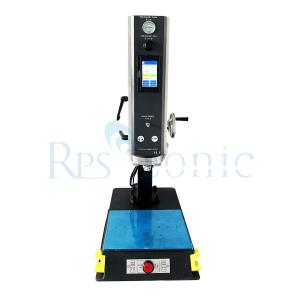
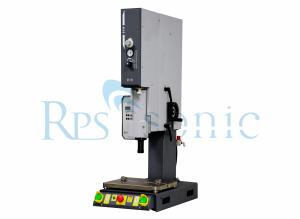
20k 2600W Ultrasonic plastic welding machine for SD Card
Working Principle
The ultrasonic plastic welding machine uses high-frequency
vibration waves to transmit to the two plastic surfaces to be
welded. Under medium pressure, the two plastic joint surfaces are
subjected to intense friction due to the action of ultrasonic
waves. The friction heat causes the plastic joint surfaces to melt
rapidly, thereby achieving the purpose of fusion in a very short
time. The welding strength can be equivalent to the body. Through
suitable workpieces and reasonable interface design, water
tightness and air tightness can also be achieved.
Features
High welding accuracy: The frequency of 20kHz is suitable for
welding precision, ultra-thin, and very fragile plastic parts. It
can meet the welding accuracy requirements of small precision
electronic products such as SD cards, ensuring that the shell of
the SD card is firmly welded and has a beautiful appearance, while
not causing damage to the precision electronic components in the
card.
High welding strength: The power output of 2600W can provide enough
energy to make the plastic shell of the SD card have a higher
strength after welding, and can withstand a certain external force
impact and pulling, ensuring the sealing and durability of the SD
card.
Non-contact welding: Ultrasonic welding does not require the use of
additional adhesives or other auxiliary materials. It is a
non-contact welding method, which avoids the pollution problems
caused by the use of materials such as glue, and will not have
adverse effects on the electronic performance of the SD card.
High degree of automation: Equipped with advanced control systems,
it can realize automated operations, such as automatic frequency
tracking, automatic power adjustment, etc. The automatic frequency
tracking function can track the changes in ultrasonic frequency in
real time to ensure the stability of the welding process; the
automatic power adjustment function can automatically adjust the
output power according to the different welding materials and
welding parts to improve the welding quality.
Application advantages
High production efficiency: It can quickly complete the welding
process of SD cards, greatly improve production efficiency, and is
suitable for large-scale SD card production. Generally speaking, a
20k 2600W ultrasonic plastic welding machine can complete the
welding of multiple SD cards per minute.
Stable product quality: Since the welding process is precisely
controlled by the machine, the quality of each welding is
relatively stable, reducing the problems of loose welding and cold
welding that may occur in manual welding, and improving the yield
rate of SD card products.
Energy saving and environmental protection: Compared with other
welding methods, ultrasonic plastic welding machines do not need to
consume a lot of energy during operation, and do not produce
harmful gases and waste, which meets environmental protection
requirements.
Applicable scenarios
SD card assembly: In the production process of SD cards, it is used
to weld the upper and lower shells of SD cards to form a complete
sealed shell to protect the internal chips and circuits.
SD card repair: For some SD cards with damaged shells, ultrasonic
plastic welding machines can be used to repair them, re-weld the
damaged shell parts firmly, and restore the normal use of SD cards.
Applications:

Ultrasonic welding is most effective with certain types of
thermoplastic materials. Here are the plastics best suited for
ultrasonic welding:
Best Suited Plastics
Polyethylene (PE):Types: Low-Density Polyethylene (LDPE) and
High-Density Polyethylene (HDPE). Characteristics: Good chemical
resistance, flexibility, and low melting point make them ideal for
ultrasonic welding.
Polypropylene (PP):Characteristics: High fatigue resistance,
lightweight, and good chemical resistance. It also welds well due
to its relatively low melting temperature.
Polyvinyl Chloride (PVC):Characteristics: Widely used in packaging
and construction, PVC can be welded effectively, especially when
using the right formulations.
Polystyrene (PS):Characteristics: Easy to weld, polystyrene is
commonly used in packaging materials and disposable items.
Acrylic (PMMA):Characteristics: While more challenging to weld than
some other plastics, acrylic can be joined using ultrasonic
methods, particularly in thin sections.
Thermoplastic Elastomers (TPE):
Characteristics: These materials combine the properties of rubber
and plastic, making them suitable for ultrasonic welding in
applications requiring flexibility.
Beverage Bottles: Joining plastic parts, creating leak-proof seals.
Grading Cards: Attaching layers or laminates, ensuring durability
and a secure bond.
Parameter
| Frequency | Power | Working distance | Input voltage | Air pressure | System language |
| 15Khz | 2500W/3000W/4000W | 75mm/100mm | 220V or 110v | 0.2-0.8Mpa | English/Chinese |
| 20Khz | 2000W/3000W | 75mm | 220V or 110v | 0.2-0.8Mpa | English/Chinese |
| 30Khz | 1000W | 75mm | 220V or 110v | 0.2-0.8Mpa | English/Chinese |
| 35Khz | 1000W | 75mm | 220V or 110v | 0.2-0.8Mpa | English/Chinese |
| 40Khz | 800W | 75mm | 220V or 110v | 0.2-0.8Mpa | English/Chinese |
Description
Ultrasonic plastic welding is the joining or reforming of
thermoplastics through the use of heat generated from
high-frequency mechanical motion. It is accomplished by converting
high-frequency electrical energy into high-frequency mechanical
motion. That mechanical motion, along with applied force, creates
frictional heat at the plastic components’ mating surfaces (joint
area). This allows the plastic material to melt and forms a
molecular bond between the parts.
Material Consideration
To bond two thermoplastic parts, it is necessary that the materials
be chemically compatible. Otherwise, even though both materials may
melt together, there will be no molecular bond.
A good example would be trying to weld polyethylene to
polypropylene. Both of these semi-crystalline materials have a
similar appearance and many common physical properties. However,
they are not chemically compatible and are therefore unable to be
welded to each other.
Like thermoplastics (i.e., materials with the same chemical
properties) will weld to themselves. For example, one ABS part will
weld to another ABS part.
Dissimilar thermoplastics may be compatible only if their melt
temperatures are within 40ºF (6ºC) and they are of like molecular
structure. For example, it is likely that an ABS part could be
welded to an acrylic part because their chemical properties are
compatible.
Generally speaking, only similar amorphous polymers have an
excellent likelihood of being welded to each other. The chemical
properties of any semi-crystalline material make each one only
compatible with itself. When the materials to be welded are
compatible, several other factors may affect the adhesive bonding
of the parts. These factors include hygroscopicity, mold release
agents, lubricants, plasticizers, fillers, flame retardants,
regrind, pigments, and resin grades.
Features
1. The transducer adopts self-developed high-performance transducer
with stable performance.
2. Matching Taiwan Airtec cylinder, with strong power and good
stability.
3. The first dovetail groove design of the square column increases
the rigidity of the mechanism, prevents backwards, and ensures the
consistency of product welding. Improve welding precision.
4. Suitable for power output, suitable for welding small-sized and
high-precision products, with good welding effect.
5. Alloy layer welding mold, not easy to wear, strong and durable.
6. Unique horizontal screw design, mold debugging is simple and
convenient.
7. Welding limit system, the workpiece will not overflow after
welding.
8. Automatically chase the frequency when starting up, without
manual frequency adjustment, and automatically detect frequency
abnormalities.
9. Intelligent protection, when the equipment fails, it will
automatically alarm and prompt, the machine will be locked into the
protection state, and then enter the working mode after the fault
is cleared.
10. Dual boot mode, better protect your personal safety.
How does ultrasonic welding compare to other plastic joining
methods?
Ultrasonic welding is one of several methods used for joining
plastic materials, each with its own advantages and disadvantages.
Here’s a comparison of ultrasonic welding with other common plastic
joining methods:
1. Ultrasonic Welding vs. Adhesive Bonding
Speed: Ultrasonic welding is much faster, often completing welds in
seconds, while adhesive bonding requires curing time, which can
slow down production.
Cleanliness: Ultrasonic welding does not require adhesives,
resulting in a cleaner process with less waste. Adhesive bonding
can introduce contaminants and require additional cleanup.
Strength: Ultrasonic welds typically provide stronger, more durable
joints than adhesive bonds, especially in high-stress applications.
Material Compatibility: Adhesives can bond a wider variety of
materials, including different types of plastics and other
substrates, whereas ultrasonic welding is best suited for
thermoplastics.
2. Ultrasonic Welding vs. Heat Staking
Process Time: Ultrasonic welding is generally faster than heat
staking, which involves heating a metal component to melt a plastic
part and create a joint.
Precision: Ultrasonic welding offers higher precision and control
over the welding process, whereas heat staking can result in more
variability in joint quality.
Material Limitations: Heat staking requires specific designs and
can be limited in terms of the types of plastics that can be joined
compared to ultrasonic welding.
3. Ultrasonic Welding vs. Laser Welding
Speed: Both methods are fast, but ultrasonic welding can be quicker
for certain applications where immediate contact is required.
Joint Configuration: Laser welding is often better for complex
geometries and transparent materials, while ultrasonic welding
excels in straightforward assemblies and thicker materials.
Heat Affected Zone: Ultrasonic welding typically has a smaller
heat-affected zone than laser welding, which can help preserve the
integrity of sensitive components.
4. Ultrasonic Welding vs. Spin Welding
Joint Strength: Ultrasonic welding generally produces stronger
joints than spin welding, which relies on friction to generate
heat.
Material Thickness: Spin welding is often used for thicker
materials, while ultrasonic welding is more suited for thinner
sections.
Application Range: Ultrasonic welding is versatile and can be used
for a wider range of materials and applications compared to spin
welding.