| Sign In | Join Free | My burrillandco.com |
|
...rutile Titanium dioxide pigment for use in plastics. it has an inorganic as well as an organic posttreatment. TlNOX CR-1220 has an optimum particle size distribution for light scattering. Excellent tinting s...
... scattering. It shows excellent tinting strength and scattering power, strong opacity properties and strong dispersing properties with good processability characterize this pigment. TINOX CR-1220 is widely u...
... will not occur. This Rutile Titanium Dioxide is also known as Titanium White or Rutile Titanium Dioxide Powder and is often used as an ingredient in paints, inks, plastics, and food. It is highly durable, i...
Product Description: Titanium Oxide Rutile is a white powder composed of titanium dioxide, which is a chemical compound with a wide range of uses. It is a widely used pigment in paints, plastics, paper, rubber,...
...molar mass of 79.866 g/mol. It exists in crystalline form, and has many uses, including as a pigment in paint, sunscreen, food coloring, and other products. TiO2 is a highly versatile compound, and has been ...
...Titanium Dioxide (TiO2) is a white pigment used in a variety of applications, most notably in the production of Titanium White Pigment. It is an oxide with a molecular weight of 79.866 g/mol and a molar mass...
...a nano grade titanium dioxide (particle size of 30-50nm) specially developed by our company for high-end automotive paint. It is used for automobile repair paint, and its ......
...Titanium Dioxide Rutile is a versatile and widely used product in the chemical industry. It falls under the category of Titanium Dioxide, a popular compound known for its various applications. The Titanium D...
...h a range of applications due to its unique properties. The product, Titanium Dioxide Rutile, is characterized by its insolubility in water. This attribute makes it ideal for various industrial uses where wa...
R-2240 is a sulphate process rutile pigment intended for use in plastics. it has an inorganic posttreatmentas well as organic posttreatment. TlNOX R-2240 offers outstanding performance in plastics application ...
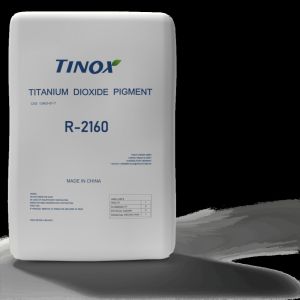
TINOX R-2160 is a rutile universal pigment produced via sulphate process for waterborne and solvent borne paint systems. Produced with advanced technologies, particularly in terms of particle size control, this...
R-2140 is a versatile rutile TiO2 pigment via sulphate process which is used in paints and coatings. It provides good optical properties in the pigmented system. This TiO2 pigment type provides good gloss prope...
TINOX R-2160 is a rutile universal pigment produced via sulphate process for waterborne and solvent borne paint systems. Produced with advanced technologies, particularly in terms of particle size control, this...
CR-1120 is a rutile universal TiO2, pigment from the chloride process which can be used in paints and coatings as welas in plastics. Produced with advanced technologies, particularly in terms of particle size c...
TINOX R-2160 is a rutile universal pigment produced via sulphate process for waterborne and solvent borne paint systems. Produced with advanced technologies, particularly in terms of particle size control, this...
... dioxide Rutile is highly stable and has excellent thermal stability, with a melting point of 2960 °C and boiling point of 2960 °C. It does not undergo hazardous polymerization under ......